Secure entry. Readily available escape.
A school’s access control system needs to support everyday safeguarding and the response to an emergency. For colleges and universities, it must also accommodate public events, shared facilities, contractors and buildings with very different patterns of use.
The software is only part of the solution. The lock, exit hardware, door construction and fire alarm interface determine what actually happens when a lockdown command is issued, power fails or somebody needs to leave.
Digilec designs, installs and maintains access control systems for education sites. We also review existing installations, helping estates teams understand which doors can retain their current equipment and where a change of locking hardware could improve safety and security.
Mechanical escape or electrical release?
Electrically released escape
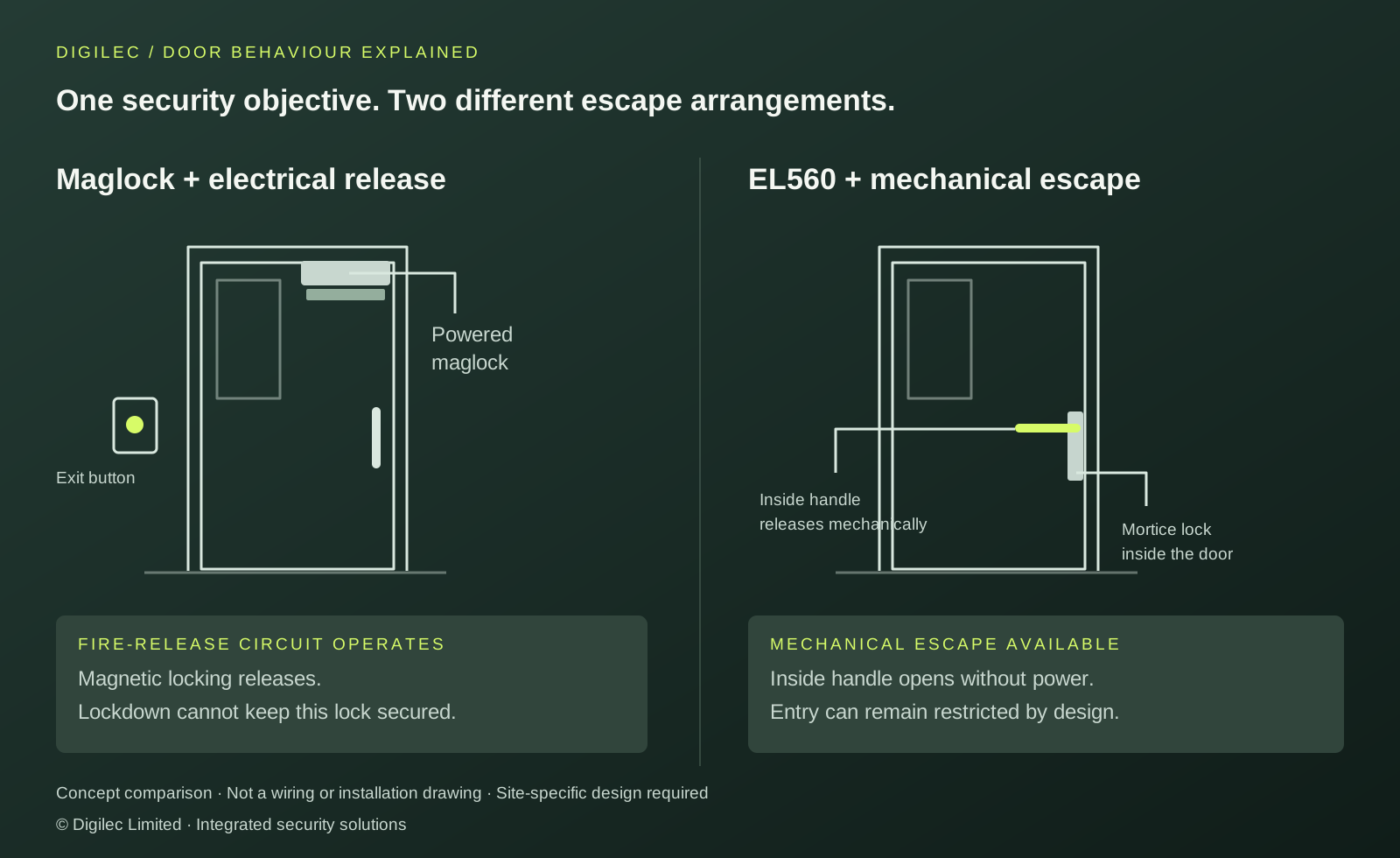
A maglock holds a door closed using electrical power. An exit button requests release; the specified emergency release and fire interface provide the required safety functions. Escape depends on the electrical locking releasing.
Mechanical free egress
Suitable electromechanical locks control entry electrically while an inside handle or approved panic device releases the door mechanically. Occupants can leave without a reader, software permission or an electrical unlock signal.
This distinction is about how the door opens from the escape side. An electrically powered access control lock can still provide mechanical escape. Equally, replacing a maglock with another electrically released lock does not automatically change the escape principle.
What happens when the fire alarm operates during lockdown?
Where a maglock is connected to a fire alarm release circuit, operation of that circuit removes the locking power—even if the access control software still shows the door in lockdown. The affected door may then be accessible from either side. A fire alarm call point can initiate that release where it forms part of the configured cause-and-effect arrangement.
That does not make every electronic locking installation unsuitable. It means the physical release behaviour needs to be understood when planning a lockdown. A software setting alone cannot preserve the security of a door whose lock has been released by a separate safety circuit.
The solution is coordinated design. Required fire and emergency release functions must remain effective. We review the hardware and interfaces with your responsible team so security arrangements support the agreed fire and emergency plans.
With mechanical free egress, it may be possible to maintain restricted entry while allowing people inside to leave immediately. Lockdown planning must also consider the location of a threat, safe routes, staff procedures and emergency-service access. It is not simply a command to lock every door.
ABLOY EL560: controlled entry, mechanical escape.
The ABLOY EL560 uses electrical control for the outside handle, while the inside handle operates the escape function mechanically. In a suitable fail-locked configuration, access-side security can be maintained when electrical power is lost, while the inside handle remains available for escape.
Because escape does not depend on electrical unlocking, a fire alarm interface is not inherently needed to release this lock for that mechanical escape function. This is not a blanket exemption from all fire-related interfaces: emergency-service access, the building’s strategy and any additional locking on the door still need to be considered.
Security built into the door
ABLOY’s published EL560 family data sheet lists EN 14846 classification 3S8D-L611, including security and drill-resistance grade 6. It describes an automatically thrown 20 mm deadbolt and blocked latch. These give a defined mechanical locking arrangement, rather than relying on magnetic holding force alone.
A lock’s classification is not a security rating for the complete door. The door leaf, frame, strike, fixings and installation matter, and a maglock’s advertised holding force is not a like-for-like comparison with an EN 14846 classification. We assess the complete arrangement.
EN 179 and EN 1125: choose for the people using the door.
EN 179 · Emergency exit
Lever-handle or push-pad emergency exit devices for situations where users are familiar with the exit and a panic situation is not anticipated. Suitable applications are assessed door by door.
EN 1125 · Panic exit
Horizontal push-bar or touch-bar devices for situations where panic may occur or occupants may be unfamiliar with the exit. This can be particularly relevant to assembly spaces and public-facing facilities.
A school or campus can need both types. A staff-only area and a hall used for public events may have different requirements. Occupancy, use, the escape strategy and applicable guidance determine the selection—not the building’s name alone.
Certification must cover the approved combination of lock, operating device and associated components. An EL560 fitted with an arbitrary handle is not automatically an EN 179 package, and an ordinary lever handle is not an EN 1125 panic device.
We can coordinate approved ABLOY escape hardware and suitable motorised panic solutions, including Strand Hardware options, with the access system. Where electrically controlled escape is required, our ABLOY-trained and certified engineers can also assess a complete EN 13637 escape door system against the agreed requirements.
Keep the escape route clear.
Approved Document B, Volume 2, paragraph 5.16 gives guidance for England that escape routes should have at least 2 m clear headroom, with door frames the only permitted projections below that height. A surface-mounted maglock or bracket projecting into the opening therefore needs careful assessment; it should not simply be treated as part of the frame exception.
A mortice lock such as the EL560 sits within the door and avoids an overhead lock projecting into the opening. We still check the clear opening, accessibility, door condition and the suitability of any modification to a fire-resisting doorset, including the required intumescent protection.
A complete system—or a focused upgrade to existing doors.
We work with access control platforms including Paxton, Salto, DoorFlow and Avigilon Alta. The right approach depends on your estate, existing investment, management requirements and the locking options supported by the selected system.
A review does not automatically mean replacing readers and software. Where compatible, we can retain the existing access platform and improve the locks, monitored inputs, door-release arrangements or operating configuration. We confirm the exact controller, lock interface, licensing and supported features before proposing changes.
- Schools and academy trusts: coordinate reception access, staff areas, teaching blocks and out-of-hours use with safeguarding and emergency procedures.
- Colleges: manage busy entrances, workshops, shared facilities and visitors without giving every user access to every space.
- Universities: plan permissions across academic buildings, laboratories, libraries and student accommodation, with practical arrangements for estates and security teams.
Our access control solutions cover new installations and extensions, with maintenance and fault support for existing systems.
Connect access events with the camera view.
Compatible CCTV and access control integrations can help authorised staff review the video associated with a forced-door alarm, a door held open or an access event. Live views can support an incident response, while recordings help establish what happened afterwards.
We select the integration around the platforms and licences in use, alongside camera coverage, retention and staff permissions. Video supports informed decisions; it does not replace the door’s independent escape provisions. Explore our commercial CCTV solutions.
Know how your doors will behave before an incident.
For schools and colleges in England, Department for Education guidance calls for security planning based on realistic site risks and proportionate measures, alongside safeguarding and emergency procedures. It does not prescribe a single lock type. This insight supports that planning; it is not a site-specific risk assessment.
Digilec has operated since 2011 and installed well over 1,000 access-controlled doors. We bring together practical knowledge of controllers, readers, locks and door operation to help your team plan improvements.
- Review existing access control, locking hardware and escape-side operation.
- Confirm what lockdown, fire release, emergency override and power loss do at each relevant door.
- Check door monitoring, closing and latching, power supplies and standby batteries where fitted.
- Coordinate EN 179, EN 1125 or EN 13637 equipment with the requirements provided by your project team.
- Identify targeted upgrades and agree installation, commissioning, staff handover and maintenance.
Your responsible team determines the fire and emergency strategy. Digilec advises on suitable equipment and implements the agreed arrangements; we do not act as the building’s fire risk assessor. We can work alongside estates teams, consultants, architects and M&E contractors throughout the project.
Technical references
Manufacturer documentation and guidance used for this insight: