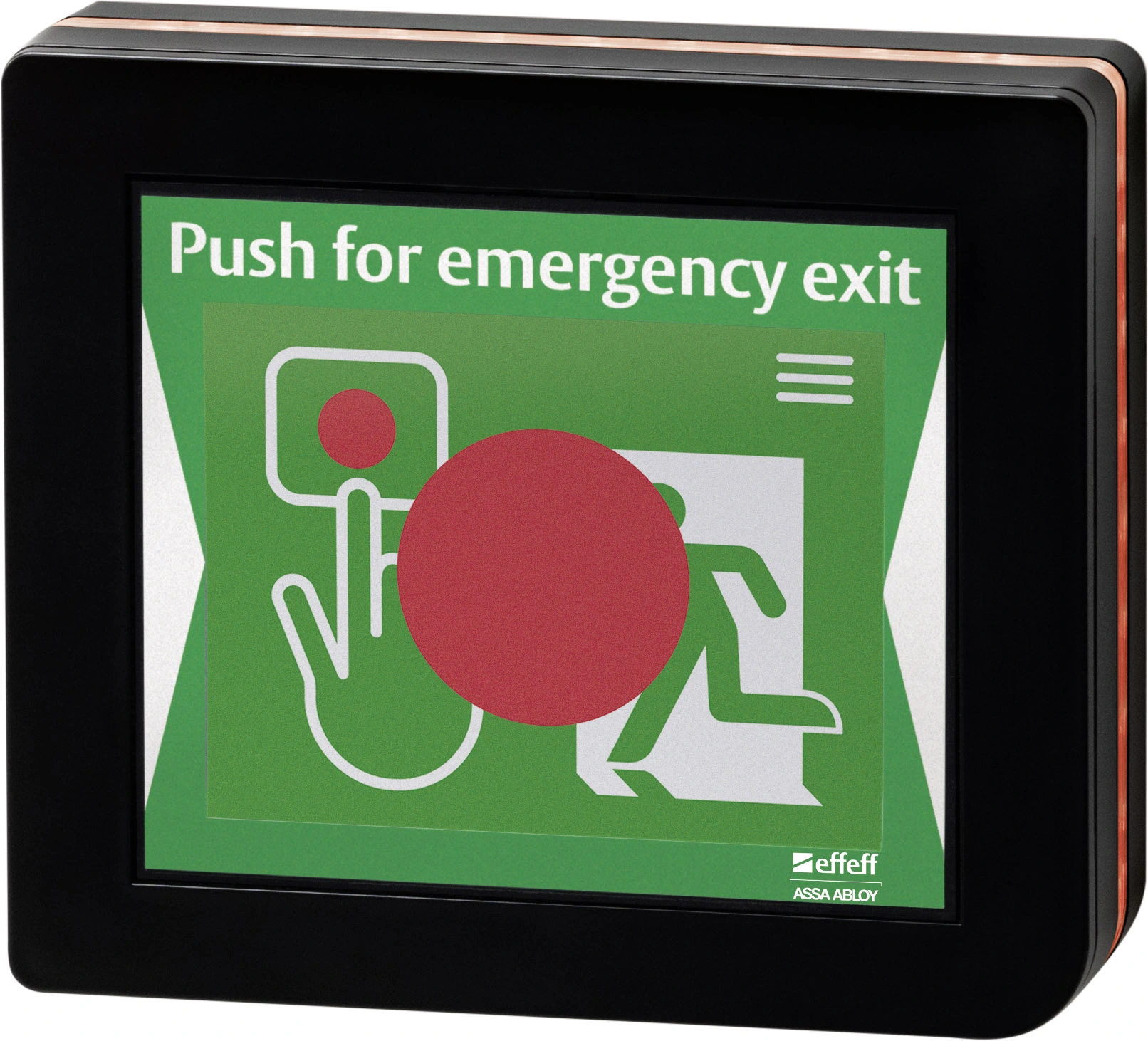
A controlled escape door, with safety built into the system.
Escape doors need to provide a way out in an emergency. They can also create a security challenge when they are used as shortcuts, to leave restricted areas or to bypass a building’s normal access arrangements.
ABLOY’s effeff ePED escape door system (EDS) is designed to address both needs. The Display Door Terminal provides an identifiable emergency release point, while the matched control and locking equipment manage the electrically secured door. The approved system combination is tested to BS EN 13637:2015, the standard for electrically controlled exit systems for use on escape routes.
For building operators, that means a coordinated solution for door security, emergency operation, status indication and monitoring. It can be designed into a new project or assessed as an upgrade to an existing access-controlled escape door.
Immediate release—or time to assess an alarm.
The ePED display terminal can operate with or without a release delay. A delay is an optional function for specifically approved applications; it is not a requirement for every EN 13637 installation.
Immediate release
No programmed delay after emergency activation. Suitable where the agreed escape strategy requires immediate electrical release.
Local delay · T1
A configured local emergency release delay of up to 15 seconds, where approved for the application.
Central control · T2
A central-control delay of up to 180 seconds, requiring the additional central escape-route control equipment and agreed operating arrangements.
What a 15-second local delay can offer
When the emergency release is activated, the terminal signals the event and displays the remaining delay. With suitable alarm monitoring and CCTV integration, security staff can assess what is happening at the door and respond to suspected misuse. The configured local period then expires and the electrical escape locking releases.
That short assessment window can be valuable at a boundary between public and restricted areas. It can help an operator investigate an unexpected activation while keeping release governed by a tested escape-door system.
T1 and T2 are different operating arrangements
T1 describes the local delay; T2 relates to the centrally controlled arrangement. The 180-second capability is not a standalone terminal setting for every door, and the two figures should not be added together as a general release allowance. The installed equipment, configuration and approved safety concept determine how the door operates.
Delay must be agreed for the building. EN 13637 describes system performance; it does not automatically permit delayed escape in a particular premises. The responsible fire-safety team and relevant approving authorities must agree the arrangement, including emergency overrides and any central supervision. Digilec implements the agreed design.
Different buildings. Different reasons to choose EDS.
Some sites benefit from an approved assessment window. Others need immediate release with the assurance of a complete, tested escape-door arrangement. We select the approach around the door’s role and the agreed escape strategy.
Airports and transport buildings
Consider doors between public circulation, staff areas and restricted zones. Where authorised, a local delay combined with an alarm can give a security team time to assess an activation and coordinate a response.
Shopping centres and retail
Help manage misuse of escape doors around stock areas, service corridors and public spaces. The terminal’s status indication and alarm can support staff awareness, with delayed release considered only where approved.
Museums and public venues
Coordinate escape provision with the protection of collections, controlled areas and visitor routes. A monitored escape-door solution can make unexpected use easier to identify and investigate.
Offices, schools and universities
Use immediate release where required, alongside controlled everyday access. Clear emergency operation and a matched, performance-tested system can support a consistent approach across occupied buildings and campuses.
These are potential applications, not a recommendation to delay all doors in those sectors. Individual doors within the same building may require different arrangements.
Upgrade escape control. Keep your readers and software.
ePED provides the escape-door control layer alongside the access control system. Normal access permissions can remain managed by the existing readers, cards, credentials and software.
The terminal includes an input for temporary release from an access control system. That allows integration with platforms such as DoorFlow, Avigilon Alta, Paxton, CEM Systems and other manufacturers through a suitably configured release output. A particular brand of access software is not a prerequisite; Digilec checks the controller outputs, electrical interface and required door behaviour.
On an existing installation, the Display Door Terminal can take over the emergency release function previously provided by a green break-glass unit. The upgrade also includes the appropriate ePED locking interfaces, approved locking hardware, power arrangements and wiring. Keeping the readers and management platform is often possible; simply replacing the break-glass unit while retaining an arbitrary lock does not establish EN 13637 conformity.
Normal exit can be provided by an appropriately connected exit button or authorised read-out arrangement where specified. This is coordinated separately from the terminal’s emergency release function.
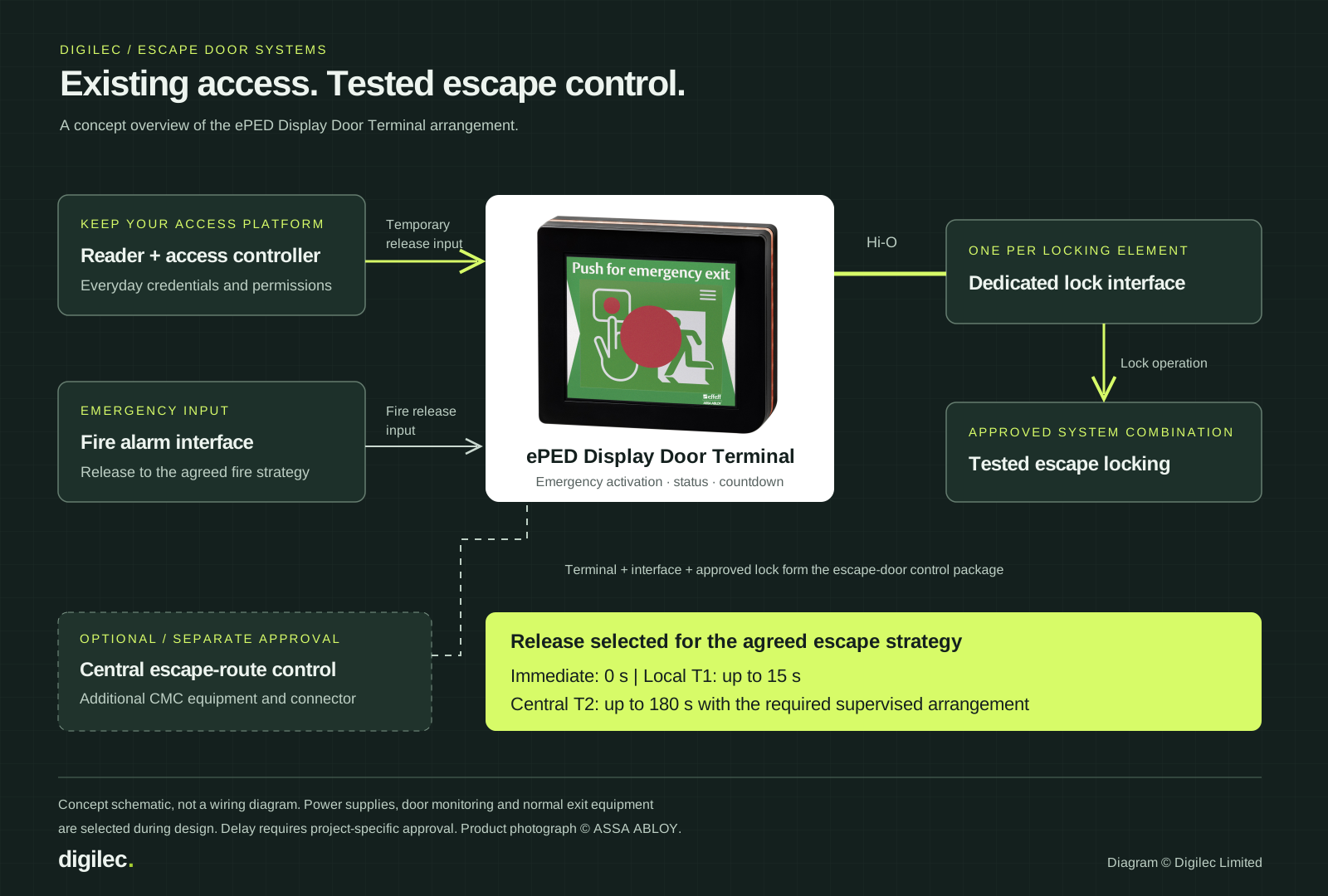
View the full-size schematic
We can also coordinate door status and alarm information with the wider security operation, including CCTV or building monitoring where suitable interfaces are available. See our access control solutions for the wider integration options.
EN 13637 applies to the complete escape-door solution.
An electrically controlled exit system includes the emergency actuation element, control element and electrical locking element. Their performance as a permitted combination matters: a compliant-looking terminal alone is not a certificate for the finished installation.
The ePED architecture uses dedicated locking interfaces connected through the Hi-O bus. Each controlled locking element needs the appropriate interface and approved connection. Lock choice can include suitable tested escape-door locks or holding magnets from the manufacturer’s approved combinations; the correct package is selected for the doorset.
Digilec checks the terminal, locking interfaces, locking devices, power supply and related door hardware against the manufacturer’s test evidence. On double doors we assess both leaves, their operation and the locking arrangement. Fire-door suitability, mounting, intumescent protection and any mechanical escape hardware also require coordination with the doorset evidence.
We review the relevant EN 13637 certification, approved component list and manufacturer’s declarations for the selected package; the exact documentation must match the products being supplied.
Safety functions that go beyond an ordinary release switch.
The manufacturer describes a safety architecture intended to preserve emergency release under faults. Its published safety features include fail-unlocked behaviour for a short circuit or interruption in the conductor to the locking unit, and automatic release on loss of operating voltage. Emergency power supplies are permitted, so a mains failure is not necessarily the same as loss of operating voltage at the escape-door system.
The Display Door Terminal also provides a fire alarm release input. We coordinate the fire alarm interface and its release behaviour with the agreed design, including BS 7273-4 where applicable. Emergency and fire release must remain effective independently of normal access permissions; access software should not become the only means of escape.
ABLOY states that the delayed-release safety function is tested to EN 61508 Safety Integrity Level 2 (SIL 2). This supports the system’s functional safety approach; it does not mean a delay is suitable for every building.
Clear pictograms, an illuminated status frame and audible signalling give occupants and staff information at the door. Where delay is enabled, the displayed countdown helps explain the release sequence.
ABLOY-certified installation, coordinated with your building.
Digilec engineers are trained and certified by ABLOY to supply and install its ePED escape door systems. We can design the equipment arrangement, integrate it with existing access control, install and commission the system, and provide ongoing maintenance.
We have operated since 2011 and installed well over 1,000 access-controlled doors. Our work covers the readers and controllers, the locking hardware, the fire interface and the practical operation of each door.
- Survey and planning: review the doors, existing access system and the escape requirements supplied by the project’s responsible team.
- Package selection: confirm the permitted terminal, interfaces, locking hardware and supporting equipment.
- Integration and commissioning: test normal access, emergency activation, the agreed delay or immediate release, fire interfaces and relevant fault conditions.
- Handover: explain door operation, authorisations, alarm handling and the agreed security response.
- Service and maintenance: inspect the hardware, test the safety functions and support fault investigation.
Digilec supports equipment selection and installation to the agreed escape strategy. We do not undertake the building’s fire risk assessment or decide whether delayed egress is permissible. We work with the client, consultants and responsible fire-safety team to deliver the appropriate solution.
Our access control system builder includes EDS as an option in the door locking selection, helping you plan a preliminary system for Digilec review.
Explore our support for architects and consultants, escape door standards insight and access control maintenance services.
Working on an access control installation? Our specialist ePED support for access control installers lets you bring Digilec into your team for the escape-door package, integration and commissioning, with you retaining the client relationship.
Planning an ePED upgrade?
Do we have to replace our access control system?
Usually the existing access platform and readers can be retained. We confirm that the controller can provide the required release interface, then coordinate ePED and the approved locking package with your current installation.
Does every ePED installation use a 15-second delay?
No. The system can provide immediate emergency release. A local delay of up to 15 seconds is an option only where the particular application and escape strategy permit it.
Can security staff simply cancel an emergency exit request?
A local delay should not be presented as an unrestricted right to deny escape. Centrally supervised functions require the correct additional equipment, configuration and specific approval. We establish the permitted behaviour with the responsible project team.
Can we retain the locks already fitted?
Only if the exact locking equipment is permitted in the selected tested combination and suitable for the doorset. We assess it during survey rather than assume that an existing maglock or electric lock can be reused.
Can Digilec maintain the system after installation?
Yes. We can agree planned inspections, functional testing and fault support for the escape-door system and associated access control equipment.